
Research in Action: Takeaways from six conversations with mathematics researchers

We’re recruiting UK state-funded secondary schools with KS3 to take part in a major national RCT launching in September 2026, focused on closing the maths attainment gap. Learn more by clicking here, and submit your interest by clicking here.
I’ll be honest with you. For the first decade or so of my teaching career, I didn’t read a single piece of educational research. Not one paper. I was too busy teaching, too tired after teaching, and — if I’m really being honest — I didn’t even know it was something teachers were supposed to do.
That all changed when I started my Mr Barton Maths podcast, speaking to people who knew far more about teaching and learning than I did, and subsequently had a mid-career crisis after realising everything I had done up to that point was wrong. One bright spark was that I did manage to write a book about my failings.
Ever since, I have tried to translate research findings into what it means when teachers next step into the classroom. That’s what this mini-series is all about.
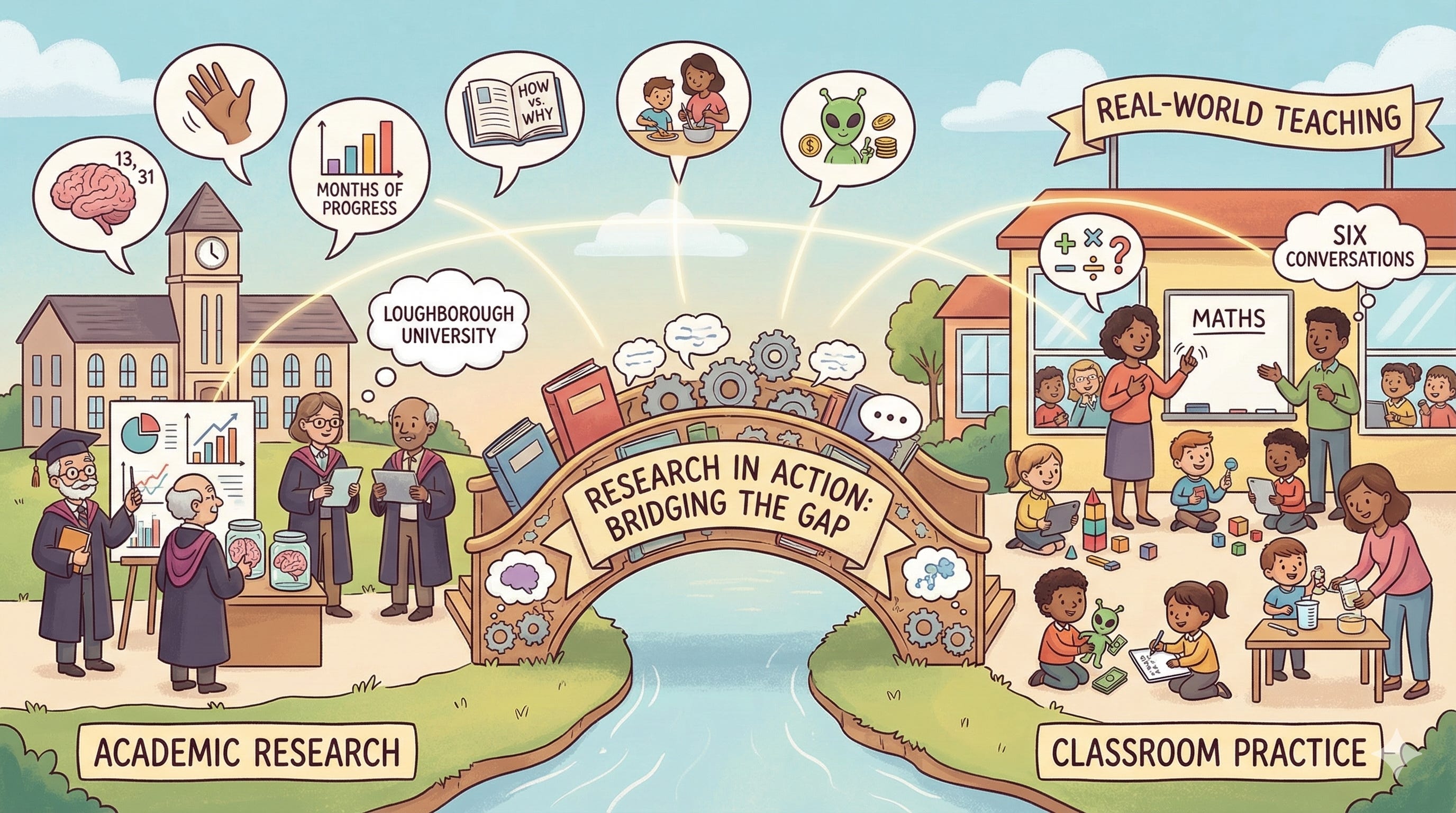
Research in Action is a set of six episodes I recorded with researchers from the Mathematics Education Centre at Loughborough University — one of the most exciting concentrations of research on mathematical cognition in the world. My brief to each of them was simple: tell me about the area of your work that you think classroom teachers most need to hear about.
Below I’ve pulled out one insight from each episode — not necessarily the headline finding, but the thing that stopped me in my tracks and that I think has real implications for what we do in the classroom.
Episode 1: Silke Goebel — Number Words, Language, and the Hidden Difficulty of Teen Numbers
Silke is a professor of psychology whose research focuses on the basic building blocks of how we represent and process numbers. We talked about everything from cultures with no number words beyond four, to why the brain needs to learn numbers at all (spoiler: unlike face recognition, number processing isn’t hardwired — it piggybacks onto other functions and is shaped by education).
The insight that stuck with me: The teen numbers in English are genuinely inverted — and that’s not just a quirk, it’s a source of real confusion for young children learning to write two-digit numbers.
When a child hears “thirteen,” they hear the three first. But when they write it, the one comes first. In languages like Japanese, Mandarin, and Korean, this problem doesn’t exist — the structure of the number word directly reflects the place value structure. In German, the inversion extends beyond the teens to all two-digit numbers, and adult German speakers still show small but measurable effects of this in number processing tasks.
What does this mean for teachers? Those classic errors where children write 13 as 31, or 24 as 42, are not signs of carelessness or confusion about digits per se. They are logical, predictable responses to a genuine structural mismatch between how we say numbers and how we write them. Understanding why children make these errors — rather than just correcting them — changes how we respond.
Listen to the episode here, or by searching for the Mr Barton Maths podcast wherever you get your podcasts.
Episode 2: Andrew Manches — The Power of Gesture in the Classroom
Andrew is a professor of children and technology at the University of Edinburgh, and his research spans physical manipulation, embodied cognition, and the effects of introducing digital technology into children’s play and learning.
We had a fascinating conversation about the tension between screens and physical learning materials, and about some genuinely exciting emerging technologies that bridge the two. But the insight I keep returning to is much more immediately practical.
The insight that stuck with me: We gesture because it helps us think — and that means gesture in the classroom deserves far more deliberate attention than it usually gets.
Andrew’s research draws on a body of evidence suggesting that when we explain ideas, we activate the same neural pathways we’d use to physically interact with the world. Gesture isn’t decoration — it’s a window into thinking. Teachers gesture a lot, but very few have ever been asked to reflect on what their gestures communicate, whether they’re helpful, or whether they could be used more intentionally.
I mentioned my own practice of silent teacher — modelling a procedure without words — and Andrew connected it directly to this research: strip the words away and the gestures become the explanation. Students pay closer attention to them, and teachers are forced to use them more precisely. If you’ve never thought about the gestures you use when you explain, it might be worth starting.
Listen to the episode here, or by searching for the Mr Barton Maths podcast wherever you get your podcasts.
Episode 3: Hugo Lortie-Forgues — Why “Three Additional Months of Progress” Might Be Misleading You
Hugo is a psychologist whose research has moved from fractions and misconceptions into something I think every teacher who engages with educational research needs to hear about: how we communicate the effectiveness of interventions, and how the choice of metric shapes what we think we’re reading.
The insight that stuck with me: The same research finding can look dramatically different depending on how it’s reported — and “months of additional progress” consistently makes effects look larger than other equivalent metrics.
Hugo’s work shows that when teachers are presented with the same intervention effect expressed as months of progress versus, say, additional points on a test, they rate the intervention as significantly more effective in the months-of-progress condition — even though the underlying finding is identical. The analogy to medicine is striking: a drug that “reduces cancer incidence by 50%” sounds transformative; “reduces cancer incidence from 2 in 1,000 to 1 in 1,000” sounds trivial. Same data. Very different impressions.
This doesn’t mean we should distrust research. It means we should be curious about how effects are communicated to us and who benefits from the chosen framing. Next time you see an intervention claiming several months of additional progress, it’s worth asking: what does that actually look like on the test itself?
Listen to the episode here, or by searching for the Mr Barton Maths podcast wherever you get your podcasts.
Episode 4: Chris Shore — What We Still Don’t Know About Mathematical Explanation
Chris spent nearly 30 years as a secondary maths teacher before joining Loughborough to work on — and study — what actually makes a good mathematical explanation. He’s currently mid-PhD on this very question, and our conversation was one of the most practically rich I’ve had on the topic.
The insight that stuck with me: There is a meaningful distinction between explaining how to do something and explaining why it works — and the latter is far more underserved than most teachers realise.
Chris describes trainee teachers who plan beautifully structured worked examples, model each step clearly, and still haven’t actually explained anything in the deeper sense. The students can follow the procedure. They may even perform well immediately afterwards. But they have no sense of what’s going on mathematically — no conceptual foothold that would help them remember it, connect it to other ideas, or recover from a mistake.
Even more striking: Chris ran a study comparing the “best” and “worst” of ten textbook explanations of the same concept (as judged by both teachers and students, who showed remarkable agreement on the rankings). He gave 500 students each version — and found no significant difference in test outcomes. His honest conclusion is that his test probably wasn’t sensitive enough to capture the difference. But the study raises a genuine question: how much do we actually know about what makes explanations work? Less, it turns out, than we might like to think.
Listen to the episode here, or by searching for the Mr Barton Maths podcast wherever you get your podcasts.
Episode 5: Vic Simms — What Parents Do at Home Matters More Than We Thought (and Differently Than We Assumed)
Vic is a developmental psychologist with a specific interest in how families support early mathematical development, and she came to this research partly through watching her own daughter discover mathematics spontaneously during everyday activities — folding towels, negotiating over food, playing in the bath.
The insight that stuck with me: Engagement with home mathematics activities does not vary significantly across socioeconomic backgrounds — but access to good-quality resources and support does.
This is an important finding, and it cuts against a narrative that can sometimes creep into conversations about disadvantage. Families from lower socioeconomic backgrounds are not engaging less frequently with home maths activities. What differs is the quality of those interactions and the availability of resources that support them. That reframes the problem considerably: it’s not about motivation or interest, it’s about support.
Vic’s work also suggests that the most effective home maths activities don’t require Cuisenaire rods on the kitchen table. They’re short, embedded in existing routines — cooking, bath time, a walk to the shops — and they work best when parents are given not just activities but the language and questions to go with them. For teachers thinking about how to communicate with families, this feels significant: the message isn’t “do more maths at home,” it’s “here’s how to notice the maths that’s already there.”
Listen to the episode here, or by searching for the Mr Barton Maths podcast wherever you get your podcasts.
Episode 6: Iro Xenidou-Dervou — Financial Literacy Is Not the Same as Numeracy (and That Changes Everything)
Iro is a reader in mathematical cognition at Loughborough whose recent work has taken a sharp turn into early financial literacy — a field she admits is new, underresearched, and suddenly very timely given the UK government’s decision to embed financial education into the citizenship curriculum from 2028.
The insight that stuck with me: Financial literacy and numeracy are related, but genuinely distinct constructs — and conflating them has been quietly holding financial education back for years.
Iro’s team developed a measure called Arlo’s Adventures — a comic book in which a young alien crash-lands on Earth and has to earn money, make decisions, and save up to fix their spaceship. Crucially, there are no numbers in it. The assessment explores concepts like where money comes from, the difference between wants and needs, saving, and different payment methods — all without requiring any arithmetic.
When they tested it across 400 children in the UK, they found that financial literacy and numeracy scores were correlated but statistically distinct. This matters enormously, because it means children can develop genuine financial understanding without strong arithmetic skills, and equally, that arithmetically capable children may have serious gaps in their financial thinking. Treating financial literacy as just “applied maths” means we systematically conflate two different things — and probably teach both of them less effectively as a result.
Iro also made a point I found striking: 44% of UK adults have poor financial literacy, and 45% lack confidence managing their finances. Building those foundations in the early years — long before spreadsheets and mortgages — might matter more than we’ve previously assumed.
Listen to the episode here, or by searching for the Mr Barton Maths podcast wherever you get your podcasts.
A Final Thought
One thing that came through in every conversation was how much researchers value the perspective of classroom teachers — and how rarely those two worlds properly connect. Chris Shore put it well when he said that the knowledge of great teaching lives in teachers’ heads, and it would be extraordinary if we could find ways to extract and share it more systematically.
I hope these conversations are a small step in that direction. Each episode is available in full on the Mr Barton Maths podcast feed, and I’d genuinely encourage you to listen to any that catch your interest — every one of them went further, and got messier and more interesting, than a summary can capture.
As always, I’d love to hear what you take from them.
Definitely taking a listen to 1, 4, and 5.