
How to choose between multiple hypotheses when coaching
When there are lots of areas you could focus on, which one do you pick?
Craig explores how to weigh multiple hypotheses when coaching and observing lessons—an essential skill for supporting teacher development. With Eedi’s misconception insights and real-time student data, teachers and coaches can pinpoint exactly where students are struggling, making interventions more effective. Try Eedi by clicking here and creating your free account.
Long-time readers will know I use the hypothesis model when observing a lesson. In short, I form a hypothesis about something in the lesson that is not going as well as it could be and then gather evidence to support or refute that hypothesis. This hypothesis forms the basis of the feedback and coaching session that follows. For those interested, I have written up my entire coaching process here and recorded a 90-minute online workshop that you can share with colleagues here.
Today, I want to address a question I often receive when training coaches: When I watch a lesson and see many areas I could focus on, how do I know which one to choose?
I experienced this myself in a recent lesson observation. Here are the hypotheses I wrote down:
Because you handed out books while giving instructions, some students will not have paid attention to your instructions and will not follow them.
Because you did not check for listening during your I Do, some students will not be paying attention.
Because you have not assessed students’ ability to do negative number operations, some students will get stuck on those questions during consolidation.
Because you have Cold Called just three students during the We Do, you will not be aware of some students who got the We Do wrong.
Because you only gently reminded Riley not to call out the answer, she - or another student - will call out the answer again later in the lesson.
Because you have not planned follow-up questions when you check for understanding, you will be unaware that some students have not followed your explanation.
I gathered evidence to support several of these hypotheses. Which one should I focus on during the coaching session?
The first thing to say is that we should resist the temptation to focus on more than one area. That is a mistake I made early on in my coaching journey. I would give the teachers I supported three or four things to work on. There are two issues with this approach:
We will overwhelm the teachers we support with too much information and too many new routines to work on, so none will get implemented effectively.
We end up with the world’s worst science experiment: changing several variables means we cannot pinpoint which of our actions is changing the outcome.
So, if we are picking one area, which should it be?
One option is to choose the easiest action to implement. This approach may be appropriate if the teacher is new to coaching, sceptical, or lacks confidence. Picking a relatively easy action leads to the greatest chance of success, increasing buy-in and boosting confidence, setting you up for more impactful future coaching sessions. From our list above, working on standing still when giving instructions (instead of handing out books simultaneously) is a quick win that will lead to more students following those instructions.
Similarly, the teacher may have indicated an aspect of their teaching they would like to focus on - checking for understanding, or modelling, for example. In this case, choosing something from this area should increase buy-in and motivation.
Another option is to choose the action that is likely to impact student learning the most. This appears to be the obvious choice. However, there is a problem. Because that action may depend on other actions, trying to leap-frog these to get to the high-impact action risks everything falling down.
This is why I use the diagram in Josh Goodrich’s excellent Responsive Coacing book to help me choose the action to focus on:
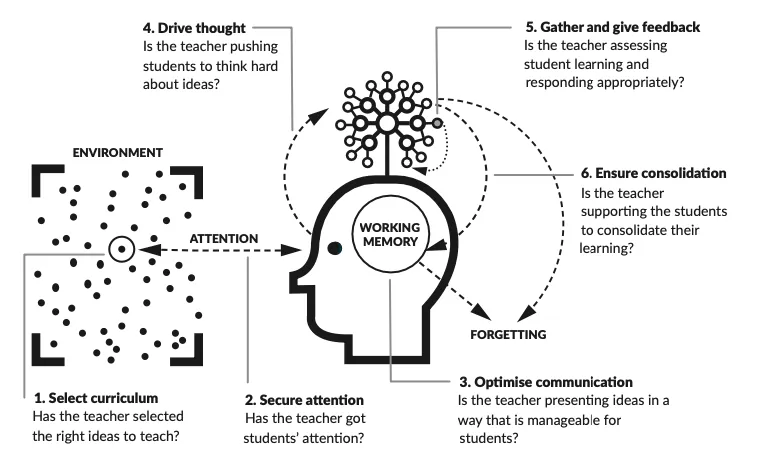
Let’s return to our list of hypotheses and see how this diagram can help us choose:
Because you handed out books while giving instructions, some students will not have paid attention to your instructions and will not follow them.
Because you did not check for listening during your I Do, some students will not be paying attention.
Because you have not assessed students’ ability to do negative number operations, some students will get stuck on those questions during consolidation.
Because you have Cold Called just three students during the We Do, you will not be aware of some students who got the We Do wrong.
Because you only gently reminded Riley not to call out the answer, she - or another student - will call out the answer again later in the lesson.
Because you have not planned follow-up questions when you check for understanding, you will be unaware that some students have not followed your explanation.
I think the action that will have the biggest impact on student learning is using mini-whiteboards to check for understanding during the We Do instead of Cold-Calling three students. This way, the teacher can assess the effort and understanding of all students instead of basing their assessment on a small sample. This action fits into #5 on Josh’s diagram: Gather and give feedback.
However, we cannot leapfrog straight to this, as we have an issue with #2 Secure attention. Because students are listening during the I Do, they are unlikely to get the We Do correct anyway. So, we need to address this first. We need to build in some checks for listening to give us data on whether students are paying attention to our I Do.
When checks for listening are ingrained in the teacher’s practice, we still cannot leapfrog to fixing the We Do until we are sure:
The I Do is clear and concise (#3 Optimise communication)
The I Do and We Do are pitched at an appropriate level (#4 Drive thought)
Once this is sorted, we can focus on gathering data from all students during the We Do. In the next coaching session, we can consider how to respond to that data.
So, while it may be tempting to jump to the action likely to impact student learning the most, a slower approach, using Josh’s diagram to determine the order, will yield more long-lasting, impactful results.
I have written up my entire coaching process here and recorded a 90-minute online workshop that you can share with colleagues here.
What do you agree with, and what have I missed?
Let me know in the comments below!
🏃🏻♂️ Before you go, have you…🏃🏻♂️
… checked out our incredible, brand-new, free resources from Eedi?
… read my latest Tips for Teachers newsletter about learning styles
… listened to my most recent pmrodcast about the Do Now?
… read my write-ups of everything I have learned from watching 1000s of lessons?
… considered purchasing one of my new 90-minute online CPD courses?
Thanks so much for reading and have a great week!
Craig